
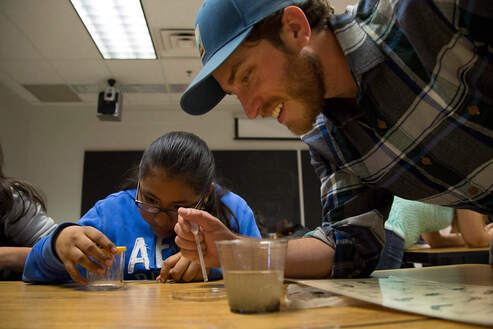
Classroom presentations are designed to be interactive and engaging as well as complement school investigations of water and water systems. Presentations can be virtual or in the classroom. Please check presentation descriptions for grade levels and access.
Request a classroom presentation and we'll schedule a time for our experts to work with your students — free of charge.
Build a Filter (Grades 5-12), Virtual & In person
(Minimum time needed: 60 minutes) How do we make water safe to drink? Students will explore the potable water treatment process by designing and building their own filters. As they work, they will use data, experimentation, and observation to determine the best materials for filtration. The hands-on elements are blended with demonstrations that illustrate how water treatment supports modern cities.
Climate Change is Water Change (Grades 6-12), Virtual & In person
Students will discover how climate and our water supply are connected, what changes we might expect in the future and how Denver Water is adapting and adjusting to our changing climate.
Engineering Our Water Supply (Grades 5–8), In person
Denver’s water flows from mountains to city through a vast network of natural and man-made infrastructure. How did Denver Water decide where to collect water and how it would flow to the city? Students gain hands-on experience with the water supply by analyzing real data and watershed topography to determine potential sites for a community water collection system. From this data and site analysis, students will build dams and simulate precipitation using a scaled 3D model. They will evaluate how well their designs meet the challenges of storing and delivering water to a city while also balancing the needs of the environment and other water users.
Get Out the Yuck (Grades K-4), In person only
What does it take to ensure our water is safe, clean, and tastes great? Students get hands-on experience with the challenges of removing contaminants from across our watersheds. Students use different tools before developing their own plan (or tool) to clean water. The lesson also includes a demonstration of how Denver Water treats our drinking water.
Hazards In Our Watershed (Grades 3-12), Virtual or In person
The news can be filled with dramatic weather events around the world. Colorado is no stranger to natural hazards that dramatically alter both our state's natural and human environments. Students will investigate how natural hazards such as drought, floods and fires impact our water system. They will learn how Denver Water prepares for these events and builds resilient systems to keep the water flowing and have a chance to develop their own solutions to hazards in our watershed.
The Incredible Journey (Grades 2-4), In person only
Students become a water molecule moving through the natural water cycle around the Earth. On their journey, they “record” their individual paths to reinforce their understanding of the water cycle and make this experience more memorable. Depending on grade level, the presentation can emphasize elements of the water cycle or phase shifts of the water molecule based on grade level.
Where Does Your Water Come From? (Grades 3-8), Virtual & In person
It seems like magic: we turn on the faucet and water appears. But Denver's water travels a long road from source to faucet. Students will explore how geography and climate play starring roles in the quantity of water available and the systems built to move this natural resource from where it falls to the urban drinking water system.
Please fill out our online form (minimum two-week advance notice).
If you have questions, feel free to call us at 303-219-0567, or send an email inquiry to youthed@denverwater.org.