
Watershed Protection and Management
As the water provider to 1.5 million people in the Denver area, Denver Water directly depends on healthy forests and watersheds. While Denver Water’s collection system covers approximately 4,000 square miles, or 2.5 million acres (about half of which is forested), Denver Water only owns about 2% of that land. This means that partnerships and collaboration are critical for source water protection.
Denver Water employs a long-term proactive and adaptive approach to manage source water watersheds, benefitting water quality and supply. Wildfires are the primary risk to Denver Water’s raw water supply, but Denver Water also assesses other risks including active and abandoned mines and various land uses and land use changes related to development, transportation, recreation and climate change. As collection system priorities are established, Denver Water works with watershed stakeholders to identify and implement opportunities to maintain and improve watershed health.
Forest Health and Wildfire Risk
Moderate and severe wildfires are the greatest threat to Denver’s raw water supply. Denver Water partners with the U.S. Forest Service, Colorado State Forest Service, National Resource Conservation Service and the Colorado Forest Restoration Institute to restore forest health and reduce the risk of high-intensity wildfire through the From Forests to Faucets partnership. This work restores forests to their naturally resilient conditions through thinning, patch cuts and reforestation. In addition, the Colorado State Forest Service has been Denver Water’s forester since 1985 and manages over 50,000 acres of forested land on Denver Water property.
Denver Water works with multiple federal and state agencies, research institutions, fire management partners and other Front Range water providers to identify and prioritize at-risk watersheds that will be the focus of protection measures. Taking a collaborative approach to forest restoration and wildfire mitigation amplifies the benefits of watershed protection projects.
Read more about the From Forests to Faucets Partnership in our story map.
Denver Water’s Holistic Watershed Planning Program
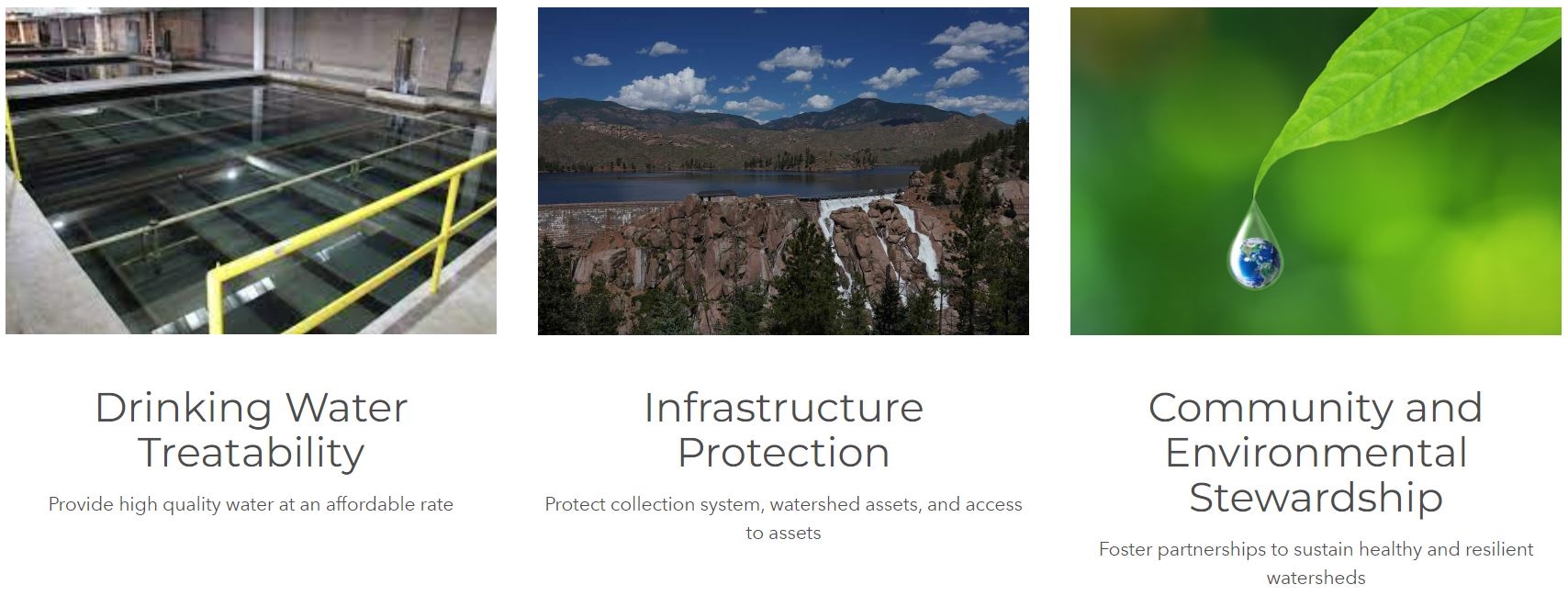
Denver Water completed a utility-specific holistic watershed plan in 2023 which included water quality and risk assessments. The plan uses a long-term proactive and adaptive approach to support water quality and supply resiliency in Denver Water’s collection system to meet customer needs and expectations. Results from risk and water quality assessments are used to prioritize projects and programs using Denver Water’s three key watershed values: drinking water treatability, infrastructure protection, and community and environmental stewardship.
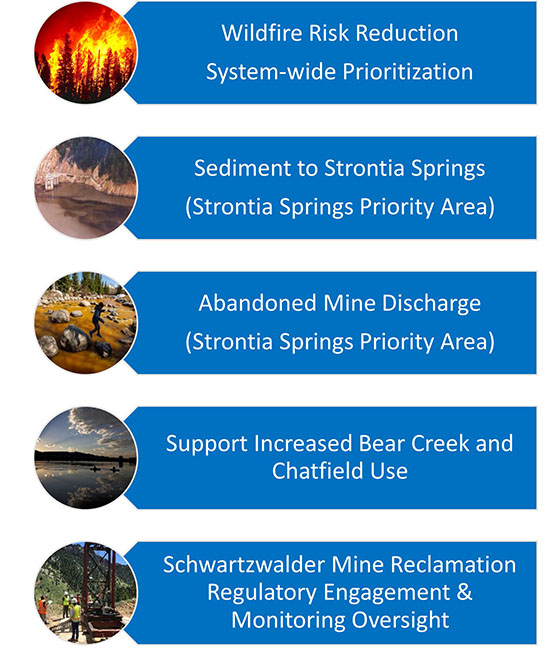
The following priorities have been identified for the collection system:
Collaborative Source Water Protection Planning
Colorado Department of Public Health and Environment developed a source water assessment and protection (SWAP) plan for Colorado in 2000. Since then, the state has supported development of more than 200 protection plans for counties and public water systems across the state, including tools for future updates, development and information for the public. Denver Water led or participated in two stakeholder-driven planning efforts: one for the Upper South Platte (2015) and one for the Fraser River Valley (2017).
Source Water Protection for the Upper South Platte
Denver Water’s formal Upper South Platte Watershed Source Water Protection Planning process was initiated in 2013. The plan was developed as part of a collaborative stakeholder process convened by Denver Water, facilitated by the Coalition for the Upper South Platte, and funded by the Colorado Department of Public Health and Environment, through the SWAP program. The planning process and final plan are designed to provide municipal water providers, local governments and the public with information about drinking water, while providing a way for water providers and community members to get involved in protecting the quality of their drinking water. The program encourages community-based protection and preventive management strategies to ensure public drinking water resources are kept safe from future contamination.
Denver Water created an interactive watershed map in 2015 as a support tool for the source water and watershed protection programs specific to the Upper South Platte. The map includes key watershed features such as major bodies of water, the emergency response contact zones, potential sources of contamination (landfills, mines, etc.), wildfire burn areas and water quality data. When a layer is activated, you can click on a feature in the map for more information and external links.
Related PDFs
Source Water Protection for the Fraser
The Fraser River Source Water Protection Partnership (FRSWPP) was established in 2015 to provide a framework for public water systems in the Fraser River Valley to collaborate on the protection of their drinking water sources from potential sources of contamination. The FRSWPP is composed of eight public water systems: Denver Water; the town of Fraser; the town of Granby; the Granby Silver Creek Water and Wastewater Authority; the Grand County Water and Sanitation District #1; the Moraine Park Water System; the Winter Park Water and Sanitation District; and the Winter Park Ranch Water and Sanitation District. The plan was completed in 2017.
Related PDFs